Showing posts with label The Sandoval Sisters' Secret of Old Blood. Show all posts

Wednesday, November 04, 2015

As Luck Would Have It: How I Became Me and Not Her


     For someone who said she'd never marry nor have children, motherhood and marriage are recurrent themes in my writing. I remain married and have two sons and no one is more surprised than a few friends from my disco days. You read that right.
     
     Motherhood and family play strongly in The Sandoval Sisters' Secret of Old Blood. Even though only one sister bears a child in the story, family and the legacy left to future generations is important to the sisters. As it is to me.  The Sandoval sisters look back at preserved memories in the ancestral diaries in order to make sense of their present.  Nothing like that was left for me; I create my present from my interpretation of the past. 

     After my parents' divorce, I lost my mother to 10-hour waitress shifts, six nights per week. I became the de facto “second mother” to my younger brother, even though I was only eight. My mom said I was smart, which is why I was blamed when my brother was hit by a speeding car when I was ten and he was three-years-old.

     It’s true that I told him to cross the street. I remember the car being way down the block. I turned away because someone behind was calling me. The next thing I remember is the screech of tires.

     That accident changed all our lives. My brother was hospitalized for several months and my mother began to breastfeed him when she visited. She also arranged for me to go to work with her at Claude’s, the new jazz hotspot on Canyon Road in Santa Fe, where she worked a 5:00 p.m. to 3:00 a.m. shift. Claude’s was a step-up in Mom’s waitressing work. It was 1959 and she was paid only $15 per week (6 nights), but on a good night she could make $25-$75 in tips. Besides the jazz, Claude had live lobster flown in daily. They arrived in wooden crates packed with ice. There were no rubber bands around their claws and they defended themselves by grabbing the tongs with which I poked them.


     I had to stay in the kitchen and out of the way, but other than the lobsters, my entertainment was Claude’s beatnik girlfriend, replete with long, dark hair that fell in a straight line to her shoulders, bangs and big glasses, straight skirts and a turtle neck sweater. And flats. No one wore athletic shoes in those days. Women either wore heels, or they wore loafers like Claude. Did I mention that Claude was a woman? A crop-haired lesbian of the men’s shirt and khaki variety. But her girlfriends were feminine, pretty . . . and smart. They toted slim volumes of poetry and were kind to me.

     
On slow nights, I got to sit on a chair outside the kitchen and listen to the music and people watch. I learned quickly not to compliment the women. “A tightwad,” Mom would say, “women are the worst tippers,” or, I might get, “She’s cheating on her husband with the saxophone player.” This person was a classmate’s mom. Worse was when she told me that an attractive man at the bar was not only married, but had a male lover. There was no room for crippling romance in my mom's life.

     Yes, my childhood education was nontraditional, so please forgive my eccentricities.


    Three major events occurred which changed my life and which were somewhat maternal. At least that’s how I choose to view them. Claude and her beatnik girlfriend came to our house one day with a gift for me: a subscription to National Geographic. While many people, celebrities and others, choose Santa Fe as their personal nirvana, I learned from that yellow-trimmed glossy that there were other destinations in the world and other ways of thinking. 


 Later, a good-looking young man, a "friend" of mom's, stopped at our home to drop off some LP’s: Gershwin, Ravel, Mozart. Mom played honky-tonk love songs; this music was new and complex. He was on his way to Spain to study flamenco. 

     I never told my mother about the bullying I endured in school, but even with her grueling schedule it became clear to her that I was scared to go to the local junior high. Mrs. Garcia lived three doors down from us and taught at a parochial school. She was stern and distant and kept her daughters in the house while I played baseball and hide-n-seek outside with her son. If I stayed too late at their house in the summer, I’d get trapped into having to kneel on the hardwood floors and say an entire rosary around the furnace grate with all nine of her kids. Somehow Mom worked it out with St. Anthony’s and Mrs. Garcia for me to attend 7th grade at a reduced tuition. I’d commute in with her in the morning. We never spoke. She didn’t smile.

     It was the best school year of my life in Santa Fe.

     American physicist, Joseph Henry:  The seeds of great discoveries are constantly floating around us, but they only take root in minds well prepared to receive them. 


Pino Daeni, Serendipity

     Writers ask "what if?" Of all the magazines one might choose to give a child, why did Claude and her lover give me a subscription to National Geographic? Why did the flamenco dancer give me those three albums? Mom was the only divorced woman on the block (which meant she couldn't receive communion)-did Mrs. Garcia hope Catholic school would save me from a disastrous future?  


      Who is the her mentioned in the title of this piece?  


      Serendipity prepared me for a different life. I've always thought that if I'd remained in Santa Fe, I would have died young. No future was tangible in my meager surroundings. My mother's youthful hopes and dreams had been squashed and she did nothing to foster any in me. With age and experience, I know now that it's possible I would have just stepped into my mother's shoes, maybe not as a waitress, but as some other hard-working female who never got to live her dreams. This would have been what my mom called "life" but for me it would have been death.                                                                                                 
                     

This blog also appears in Latino Voices at the Huffington Post: 

http://huff.to/1Pbat79

Friday, October 17, 2014

BOOK SIGNING IN BURBANK

 Book Signing at Burbank Library, October 18.

 Sandra Ramos O’Briant, author of The Sandoval Sisters’ Secret of Old Blood, will meet readers and sign books at the 
Burbank Public Library, 300 N. Buena Vista Street in Burbank, California on Saturday, October 18 from 1:00 p.m. to 4:00 p.m.

The Sandoval Sisters’ Secret of Old Blood received two awards in 2013: Best Historical Fiction and Best First Book, (ILBA, 2013).

Visitors can meet over 50 authors in person, browse books, buy books, and enter to win a Kindle Fire! 

Ms. O'Briant appears as part of the Local Authors’ Showcase, a presentation of the Burbank Public Library. The event is free and open to all.


 Copies of The Sandoval Sisters will be available for purchase.   If you already    have a copy,bring it along and have it signed!

  All proceeds from the sale will be donated to the library.

Tuesday, July 08, 2014

Character Highlights and the Dark Heartbeat of The Sandoval Sisters' Secret: Interview

Appeared July 7, 2014 in

Sandra Ramos O'Briant large

Stephanie: Pilar wants the freedom to pursue whatever she wants when she wants it.There are usually consequences to the decisions and actions we make in life that affect others around us when we want to just do what we want. Are there consequences for Pilar and how does her behavior affect the people around her?
Sandra: The youngest Sandoval sister, Pilar, had a taste of independence few women received in 19thcentury New Mexico, but just because she liked it doesn’t mean she was willful, spoiled or flamboyant. If radar had been in use in the Territory of New Mexico circa 1840, Pilar would have flown right under it. If anything, she’s guileless and assumes that others are equally open. This aspect of her personality is what gets her into trouble. Her mother died giving birth to her and left Oratoria, the eldest adopted sister, in charge of her sisters. She had been bought by the Sandovals for a sack of flour when she was eight-years-old. 
     Oratoria did not mistake Pilar’s wildness for impetuousness, but rather thought it a gift. When Pilar is betrothed to the much older Geraldo, she doesn’t run off or commit some heedless act-she accepts her fate.
     Geraldo is the perfect man for her sister, one who also prizes her “non-traditional” characteristics. My readers love Geraldo and I’m frequently asked where they can meet a man like him. He’s patient and knowledgeable about women. He doesn’t want her to have children while she’s still so young. This necessitated researching birth control methods in that time period. All of which Pilar and Geraldo use. A lot.
     Oratoria tells him, “Witches do not ride broomsticks on moonlit nights. They prefer stallions.” Pilar, on the other hand, scoffs at the whole notion of witchcraft, even when she personally suffers from its effects.
Sandra's Book Cover
And a bit of the dark heartbeat of the story:
Stephanie:  What are some of the prejudices and superstitions you feel that these women in your story face?

Sandra: My maternal grandmother was a Sandoval. In her home, there were santos, statues of saints and little altars, in every room. Many homes in Santa Fe were the same. Sounds all holy, doesn’t it? The flip side to this idolatry was a deep-seated belief that demons and witches live amongst us. In Northern New Mexico ancestor stories were interwoven with tales of witchcraft. The ritualistic power of feverish faith could be as simple as making the sign-of-the-cross over a whiff of bad luck, or carrying a wooden cross and wearing a crown of thorns in a secret ceremony, or perhaps self-flagellation. These same cultural aspects were even more evident at the time of my story.

     Back then, a whirlwind of change had descended on Santa Fe when both Texas and the U.S. decided they wanted to control the Santa Fe Trail. The people in the far northern reaches of New Spain had been isolated for two hundred years. They lacked education, and their livelihood was subsistence based. Many of their ancestors had fled the Inquisition in Spain or been banished to the remote outer regions of New Spain. 

     In my story, the Sandovals are set apart: “. . . others feared the awakening of dark powers for which the Sandovals had always been suspect. Not only had they acquired wealth in a desert frontier, they had survived Indians and epidemics while others perished. They could read, too, and their home was sumptuous with white marble pier tables, Brussels carpets and wood floors. This, while many New Mexicans lived in one-room adobe hovels alongside their goats. To make matters worse, they were handsome people. All good reasons to fear and respect them.”

     When Alma elopes with Bill and runs off to Texas with him she encounters prejudice of a different sort: she’d married into a slave-holding culture. Texas had fought hard for its independence from Mexico, and most of its Spanish-speaking residents had fled; Texans made few distinctions between Blacks and Mexicans, and the Texas Rangers were known to have lynched Mexicans. Alma’s former position in society was worthless in this new environment, but she made the most of the few friendships she made there, even training with the town doctor.

     When she returned to New Mexico, widowed and childless, she treated anyone who needed her help, including the prostitutes in a brothel. The community didn’t approve of this. They also didn’t approve of Pilar’s relationship with Monique, the half-Indian madam of the brothel.  “To the alchemy of whores and witches,” Monique said. 

     The people had lost land, been conquered by the U.S. and they were ready to place blame. The Sandoval sisters were an easy target and the crowd repeats this little ditty, “A father dies, a husband, too, and the widows, sisters all, dance under the witches’ moon.”

     Aldous Huxley’s The Devils of Loudun was an influence on my work.  It’s a history of alleged demonic possession, religious fanaticism, and mass hysteria in 17th century France.  When I read about religious persecution in the “modern” world and the effort to slut-shame women (sexual persecution), I think of this untidy piece of history.

Stephanie: Where can readers buy your book?
A message from BRAG:
We are delighted that Stephanie has chosen to interview Sandra Ramos O’Briant, who is the author of The Sandoval Sister’s Secret of Old Blood, one of our medallion honorees at www.bragmedallion.com . To be awarded a B.R.A.G. Medallion TM, a book must receive unanimous approval by a group of our readers. It is a daunting hurdle and it serves to reaffirm that a book such as The Sandoval Sister’s Secret of Old Blood merits the investment of a reader’s time and money.
*Stephanie M. Hopkins conducts author interviews and helps promote the B.R.A.G. Medallion. Participates in the Historical Fiction Virtual Book Tours. She has reviewed books for the Historical Novel Society, is Co-Admin of English Historical Fiction Authors Group on Facebook. The original interview can be read in its entirety by clicking here. 

Saturday, June 28, 2014

GIRLFRIENDS: THE OTHER WOMEN

  I almost called this piece Girlfriends, Slutdom and Mom because they’re all of a piece, a patchwork perhaps, that once assembled became me.
     

        Boys were always easier for me. We liked being outside and played rough, whereas I was never sure how to engage girls in anything beyond dolls, which didn’t interest me. They also tended to stay in the kitchen with their moms. 

        Mom proudly announced that she’d been a tomboy, too, and followed her twin brother in his rough and tumble play. As she grew older, mom embraced the “sexy” Latina image. I think it gave a boost to her self-esteem, but it meant that her goal was to get a man which invited competition from other females. At her core she embraced a 40’s cinematic femme fatale role model and distrusted all women . . . possibly even me. A girlfriend who is of my mother’s vintage recently gave me advice on how to deal with my husband over some petty argument.  “Have great sex and then do what you want anyway.” Manipulative, I said. She expressed no distaste for that word, “There’s a long line of women just waiting to steal him from you."


 She reminded me so much of my mom that I only felt affection and pity for her generation. And wonder. Could she be right? I’ve seen that certain look–threatened, possessive, and defensive–on other women’s faces when they’ve watched their husband’s reaction to a beautiful woman standing in front of them. No, the beauty wasn’t me.  My preferred role is observer, and I love women, need them even. Women take the lead in The Sandoval Sisters’ Secret of Old Blood, and sisterhood is explored in all its contexts: childhood friends, lovers, girlfriends who think nothing of cheating with your husband, a sinister mother-in-law, witchy ex-girlfriends,  daughters, blood sisters, maidens, mothers and crones. 

I’ve written previously of the bullying I experienced in elementary and middle-school (Bullied: Diversity, Differentiation, Distinction). That experience effectively isolated me and I stopped trying to make girlfriends. I had a brief respite in 9th grade when I lived with my father and stepmother in East Texas. A few girls in my neighborhood actually seemed to like me and we rode the bus to school together. No one was really dating then, but there was adolescent flirtation.

Back to New Mexico for high school and the pressure was on to date. Fortunately, I liked nerdy boys with a sense of humor. An assortment of males liked me; the girl’s locker room became hazardous when a boy sought after by one of the “popular” girls asked me to prom. Sometime in the 10th grade I was labeled a slut and I don’t think the slur came from a boy. It was the girls who shunned me.

The irony is that even though I’m now an outspoken feminist and embrace my inner slut, I remained a virgin all through high school. I refused to French kiss until I’d cleared it with the nun who taught an after-school religion class. “No it’s not a mortal sin,” she said. I’m forever grateful that she didn’t follow up that statement with what it could lead to. Perhaps she didn’t know, but it wouldn’t have mattered anyway because I wouldn’t allow my boyfriend to touch my emergent breasts because of the pimples on my chest.

The slut-shaming worked. I wasn’t sure what I’d done wrong, but in order to remedy the situation I let down all the hems on my skirts, stopped dating, and stayed home from school as much as possible. The problem with that was 1) my mother’s fear–not that I might not graduate– but that I might not get in enough practice to find my future husband. “You’ve got sex appeal,” she said, which only terrified me more. The second part of that phrase was fine, nothing wrong with appeal. But the “sex” part was a problem made all the more complicated by 2) my extreme horniness and guilt over it. 

What to do?


           Fortunately, I got to go to college in the late 60’s. The Second Wave ruled! Birth control was readily available and there were savvy girls from all over the world at UNM. What was even better, they knew nothing about me. Sure, I was a little weird, but weird was in. I could blend. Somewhat.

I’d always had opinions, but had feared speaking out. My task was to overcome that sense of powerlessness, to embrace outcast status and make it work for me.  Learning to do that was huge and the women’s movement helped me. Not only were there plenty of outspoken women from whom to learn, but I recognized the other me, before emergence, in women who came to consciousness-raising meetings. I could help them.

In grad school, my girlfriends and I had brunch every Sunday and read women’s sexual fantasies out of Nancy Friday’s My Secret Garden. Our laughter could be heard from down the street and we could have written our own book of sexual exploits, real and imagined. Peggy, one of the brunchers, met me recently in Venice Beach (A 70’s Redux.)

 Santa Monica Beach, 1977, with my friend Annie (the other bruncher.)


When I started a business, almost all of my clients were male. Female friends were rare. If it hadn’t been for my friend Susan, I wouldn’t have had a baby shower for my first child or a partner in my new business. More women entered the workforce. Now I had female employees and a new challenge balancing friendship and business: I didn’t always make the right decision.

Keogh, O'Briant & Brown, 1979

Girlfriends are still not easy. More often that not, I let them pick me. As often happens, friendships with women grew easier when I entered my 50’s. I’d relaxed, accepted that some women were not going to like me, and that it wouldn’t hold me back from expressing myself or reaching out to them. Older women have experience, both good and bad, and we all just want to have a good time. Here are some vintage thoughts from some of my girlfriends. They reflect my experience now. I'm so grateful to have arrived at this point, something I don't think my mom ever achieved:

Susan:  “My women friends have outlasted everything in this life: husbands, parents, youth, and now . . .  Even if we're not together, our laughter still rings in my ear.”

Bonnie: “No matter what I was slogging thru in terms of  family stuff, work, life in general, girl friends sustained and supported me more than any other relationships.”

Melody: “Laughter; tears; support; brutal honesty; fun; sharing of wisdom; gossip; fashion help; basic survival; boy-friend hating; physical, mental & spiritual healing; having someone really listen to our story-telling without judgment; reminders that we are worth loving, even if we do not love ourselves at times!”


Me and Anna, Runyon Canyon, 2012                  


Cindy, Missy, me: Cuba, 2012


Happy and peaceful women.


Quintana Blas Olleras,1851-1919


Tuesday, June 10, 2014

Mixed Latinos in the Flesh: Clothing Optional

Just kidding.
Join Jessica Arana, artist, Joseph Tyner, poet, Elizabeth Liang, writer, and me for Mixed/Remixed at the Japanese American National Museum in Los Angeles this Saturday, June 14 at 1:00pm. There's a full schedule of film, art and books.

Ignore the time listed below. It's 1:00 pm!!!


MASC will be sponsoring a panel on mixed Latino artists and writers at the Mixed Remixed Festival. Please make note of the new time of 3 PM. One of the panelists is Sandra Ramos O'Briant. To learn more about her work visit: www.thesandovalsisters.com

We asked our participants to answer these questions: What do you think of the word LOMA (Latinas and Latinos of Mixed Ancestry)? Does this describe you? She said: "LOMA is perfect and it describes me perfectly. Far better than 50/50, coyote, or leprechauna. Also, I appreciate not being lumped into the masculine all-inclusive Latino. My Latina and Anglo heritage speak loudly in The Sandoval Sisters' Secret of Old Blood, but the Northern New Mexican is emphasized. 

Thomas, that's a tough one for me. My mom married an Anglo so her children wouldn't experience the same discrimination she'd had to endure. Hence, the O'Briant. My bro and I experienced reverse discrimination in Santa Fe because of that Anglo last name; Latinos wouldn't accept us. The Sandoval Sisters was my shout out to the brown in me.

Thanks for including me in this program. See . . . it's all about belonging."

Sunday, December 08, 2013

PEACE LOVE & JOY DISCOUNT ON THE SANDOVAL SISTERS

As many of you know, the last few months have been rough on my family with two funerals, lots of travel, and a crushing workload for which we've had to play catch-up. There have been some high notes for me which have helped me keep my focus. The reviews for The Sandoval Sisters continue to be outstanding, and I want to share my good fortune with you.

Books make great presents. My gift to you is a special discount for the paperback version of The Sandoval Sisters’ Secret of Old Blood. $7.99 through the end of December. Go here to purchase: http://bit.ly/16J3A47

Be sure to enter this special discount code when you check out: UV8WT22L  

Peace, Joy, Love


Thursday, October 10, 2013

Journey's End?

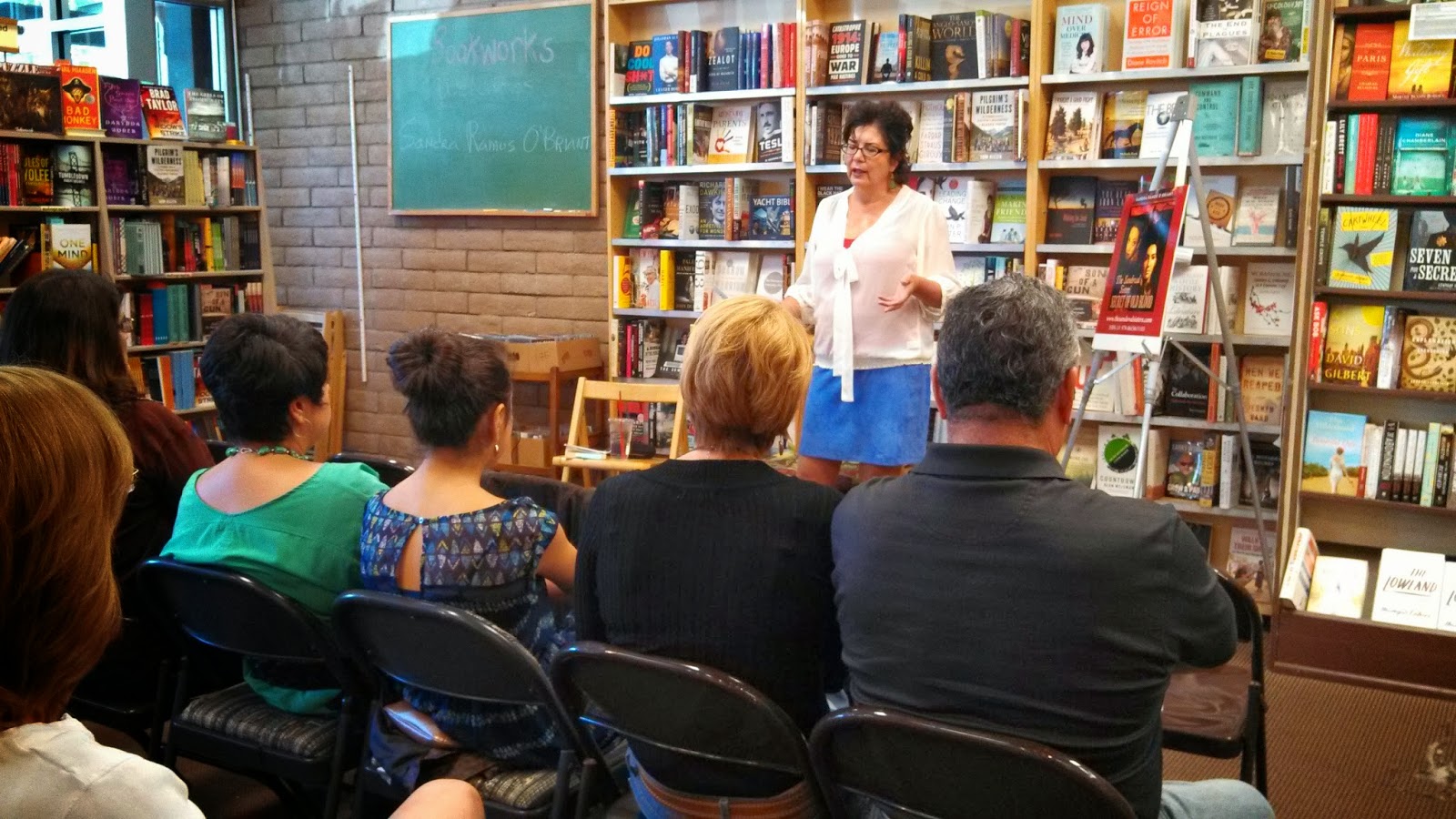
At Bookworks in Albuquerque. Photo by Jocelyn Fafard, UNM.


Hard to believe that just 7 days ago I returned to L.A. after making a 2000 mile round trip to New Mexico for signing and reading of The Sandoval Sisters' Secret of Old Blood. I look happy, don't I?

That's because I made it from Taos to Albuquerque in record time and the seats were filled with family–my brother and his partner, my cousins and their family, strangers who crept out of the aisles and lingered, and an online comadre, Dawn Wink (her book, Meadowlark is just out), who drove down from Santa Fe with her family. Hail to book lovers!

Jocelyn Fafard is a UNM student who arrived with her mom to interview me for her journalism class. The two stared off in opposite directions when I read a scene ripe with sexual awakening and intrigue but the stage was set and I forged ahead. Shoppers edged closer to hear and I looked at my brother who beamed with pride for his big sister and repentant childhood tormentor.


Dawn Wink wrote a review of The Sandoval Sisters for StoryCircle.


 "Was there an autobiographical aspect to the book?"

A bit. The book is set circa 1841-1848 in Santa Fe. I'm old, but not that ancient. Yet, I have passed through distinct stages in my life: maiden, mother and yeah, crone. Each of the Sandoval Sisters' is unique and distinct from the other, but family loyalty is important to them. They've been gifted with a certain joy I experienced in a moment of time. Some of Alma's experiences in Texas are reminiscent of my mother's sojourn there when she married my dad. And la gente's superstitions are the ones that vibrated throughout my family and surrounding community in Santa Fe.

My brother and Dawn had to head back to Santa Fe, but my cousins took me out to Sadie's, a popular Mexican restaurant in Albuquerque.         

Julia Flowers, my cousin's granddaughter, appeared in Bless Me, Ultima (my review).  
 She didn't eat all that by herself!

The next day it was time for Joey and me to hit the road.  This time I took it easy, with frequent stops for photos.  New Mexico segued into Arizona.


Same backdrop but now with a colorful toy train crossing. I so wanted to hear the train whistle.


 These shacks near a reservation. I pulled over to give Joey water and a walk and ended up buying a shell necklace from a vendor also named Sandra.


This journey brought me back in time–to memories of my mom, my childhood, the bullies who made my girlhood fraught with sorrow, to the resilience, and yes, even the creativity I learned to counteract them and pass the lonely winter nights when my mom worked, my brother slept and the wind howled outside.

The 2000 mile round trip also brought me forward in time to the present I've created for myself. It was an opportunity for me to connect on a deeper level with my brother and to continue to try to understand my deceased mother.  I spoke at Santa Fe High and hope that what I revealed to the students might give a few of them hope that there is life beyond high school and out of Santa Fe. 

Santa Fe was at once more horrible (with such an Anglicized reverence for all things ethnic that the heart of Native American and Mexican and Hispanic lost its relevance for me; there are diamond vendors cropping up around the plaza, reputedly money laundering vehicles) and greater than my youthful experience and rejection of it, but NM, and especially Taos warmed my heart.  

NM mountains and vast, blue sky over the rear of my truck at the dog park, my favorite place in Santa Fe. I met the nicest people there; they were all smiling and so were their dogs.


Imagined my husband and I watching the sunset there, holding hands, really looking at each other.


"Sometimes you get to meet yourself in the midst of running away."


Oratoria, the eldest sister:  "Which are the more true, the memories then or those simmered over time?"

Sandra Ramos O'Briant:  "There's a dissonance to memories. Like heat rising off the desert and creating a mirage, the art is in taking the distortion and helping the reader to see."